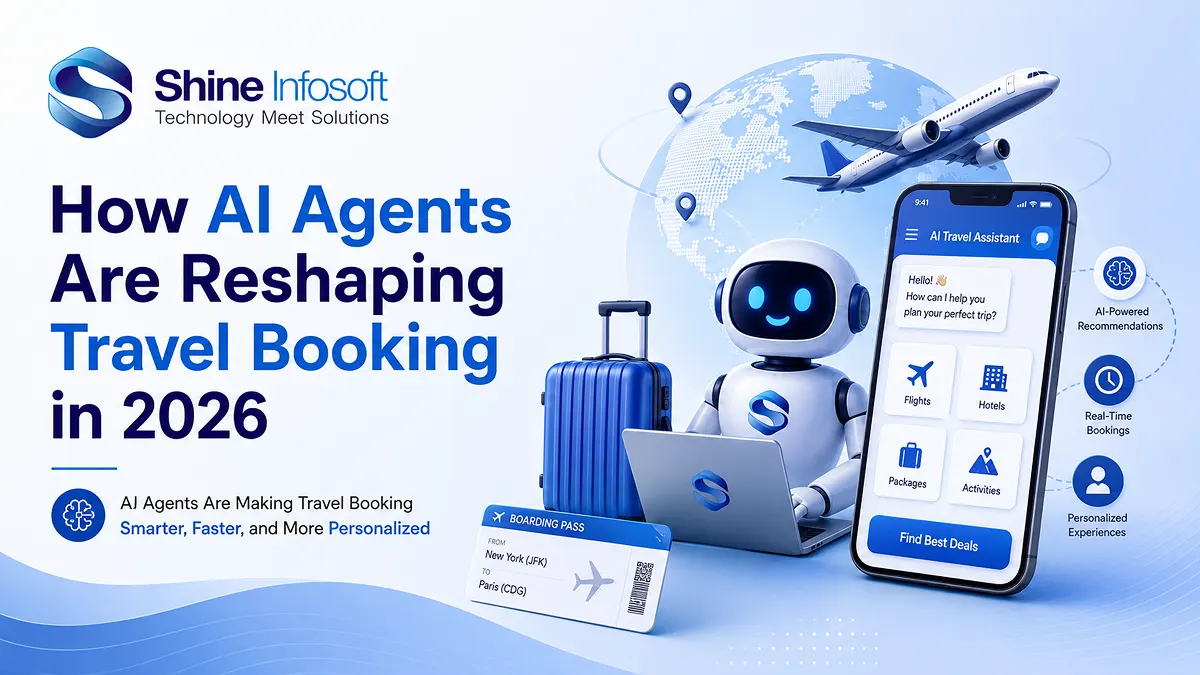
Travel booking is changing quickly. Travelers no longer want to spend hours comparing flights, hotels, destinations, reviews, and activities across multiple websites. They want a faster and more convenient way to plan their entire trip.
This is where AI agents are transforming travel booking in 2026.
Unlike traditional chatbots that simply respond to questions, AI travel agents can understand a traveler's requirements, make decisions, compare available options, and complete multiple steps of a booking journey. From finding suitable flights to recommending hotels and creating personalized itineraries, AI agents are becoming an important part of modern travel technology.
For travel companies, this shift creates an opportunity to deliver better customer experiences while improving operational efficiency and increasing conversions.
What Are AI Agents in Travel Booking?
AI agents are intelligent software systems designed to understand user goals and perform tasks with limited human intervention.
In the travel industry, an AI agent can understand a request such as:
"I want to travel from Mumbai to Paris for seven days in October. I prefer a budget-friendly hotel near the city center and want to include sightseeing activities."
Instead of providing a simple list of links, an AI travel agent can analyze the requirements, search relevant options, compare prices, consider preferences, and help build a complete travel plan.
This makes AI agents different from conventional travel chatbots.
Traditional chatbots mainly follow predefined conversation flows. AI agents can use artificial intelligence, natural language processing, recommendation systems, APIs, and automation to handle more complex travel tasks.
Why AI Agents Are Becoming Important in Travel Booking
Travel booking involves many decisions. Travelers often need to compare prices, schedules, locations, ratings, cancellation policies, baggage rules, and other details before making a decision.
This process can become overwhelming.
AI agents simplify this experience by acting as a digital travel assistant.
They can understand a traveler's intent and help reduce the amount of manual research required. Instead of searching separately for flights, hotels, restaurants, transportation, and activities, travelers can interact with one intelligent system.
For travel businesses, this can create several advantages, including improved customer engagement, faster booking journeys, personalized recommendations, and more efficient customer support.
1. Personalized Travel Recommendations
One of the biggest ways AI agents are reshaping travel booking is through personalization.
Travelers have different preferences. Some prioritize price, while others care more about comfort, location, luxury, family-friendly facilities, or unique experiences.
AI agents can analyze information such as previous searches, booking history, stated preferences, budget, travel dates, and trip purpose to provide more relevant recommendations.
For example, a business traveler may receive recommendations for hotels close to business districts, while a family traveler may see properties with larger rooms, family activities, and convenient transportation.
This creates a more relevant booking experience than showing the same recommendations to every customer.
2. Smarter Flight and Hotel Comparisons
Comparing travel options can take significant time.
AI agents can make the process easier by analyzing multiple options and presenting recommendations based on the traveler's requirements.
Instead of simply showing the cheapest flight, an AI agent could consider:
Flight duration
Number of stops
Departure and arrival times
Baggage allowance
Airline preferences
Price
Cancellation conditions
Similarly, hotel recommendations can consider location, ratings, amenities, price, room type, and traveler preferences.
The goal is not simply to find the cheapest option but to identify the best option for a particular traveler.
3. Conversational Travel Booking
Travel booking is becoming more conversational.
Instead of filling out multiple forms and filters, users can explain what they want naturally.
For example:
"I need a relaxing beach vacation for two people next month, preferably somewhere warm, with a hotel under ₹15,000 per night."
An AI agent can interpret the request and begin searching for suitable destinations and properties.
Users can then refine their requirements naturally:
"Show me options with direct flights."
"Only include hotels with breakfast."
"Can you find something closer to the beach?"
This conversational approach can make travel booking feel more like speaking with a personal travel advisor.
4. AI-Powered Itinerary Planning
Planning a trip involves more than booking a flight and hotel.
Travelers also need to decide what to do once they arrive.
AI agents can help create personalized itineraries based on travel duration, interests, budget, opening hours, transportation options, and location.
For example, an AI agent can create a three-day Paris itinerary that includes museums, restaurants, shopping areas, and sightseeing attractions while considering travel time between locations.
The itinerary can also be adjusted when the traveler changes their preferences.
If the traveler says, "I don't want to visit museums," the AI agent can replace museum activities with outdoor experiences, shopping, food tours, or other suitable activities.
5. Real-Time Travel Assistance
The role of AI agents doesn't necessarily end after a booking is completed.
They can continue supporting travelers throughout their journey.
For example, an AI travel agent could help users find alternative flights when a flight is delayed, suggest nearby restaurants, provide directions, explain hotel policies, or help modify travel arrangements.
This creates an ongoing digital travel assistant rather than a system that is used only during booking.
For travel companies, this can also reduce the workload on customer support teams by handling common requests automatically.
6. Faster Customer Support
Customer support is a major part of the travel industry.
Travelers may have questions about bookings, cancellations, refunds, baggage, check-in, hotel policies, or itinerary changes.
AI agents can provide immediate responses to many routine questions.
Instead of waiting for a customer service representative, travelers can receive assistance at any time.
More complex cases can still be transferred to human agents when necessary.
This creates a hybrid support model where AI handles repetitive tasks while human teams focus on situations that require judgment, empathy, or specialized assistance.
7. Dynamic Pricing and Booking Opportunities
AI agents can also help travel businesses analyze demand and customer behavior.
Travel companies can use AI-powered systems to identify booking trends, demand patterns, seasonal changes, and customer preferences.
These insights can support dynamic pricing strategies and targeted offers.
For example, an AI system may identify increasing demand for a destination during a particular period and help businesses adjust inventory and pricing strategies accordingly.
AI agents can also recommend relevant upgrades, additional services, or travel experiences based on customer requirements.
This can create new opportunities for travel businesses to increase revenue while providing more relevant offers.
8. Voice-Based Travel Booking
Voice interaction is another area gaining importance in travel software development.
Instead of typing requests, travelers can communicate with AI systems through voice.
A traveler could say:
"Find me the earliest flight to Dubai tomorrow morning."
The AI agent can interpret the request and provide suitable options.
Voice-based interactions can make travel services more accessible, particularly when users are busy, driving, walking, or using mobile devices.
As conversational AI becomes more advanced, voice may become another important channel for travel booking and customer service.
9. AI Agents Can Connect Multiple Travel Services
A major advantage of AI agents is their ability to work with multiple systems.
A modern travel platform may need to connect with airline APIs, hotel APIs, payment gateways, car rental platforms, travel insurance providers, maps, and activity providers.
AI agents can work as an intelligent layer between travelers and these services.
Instead of forcing customers to navigate multiple platforms, travel businesses can create a unified experience.
This is especially valuable for online travel agencies, tour operators, hotel businesses, and travel management companies looking to build more intelligent digital platforms.
Benefits for Travel Businesses
The impact of AI agents isn't limited to travelers.
Travel companies can also benefit significantly.
Improved Customer Experience
AI agents can provide faster responses and personalized recommendations, helping customers find relevant options with less effort.
Increased Booking Conversions
When travelers receive recommendations that closely match their needs, they may be more confident about completing a booking.
Reduced Operational Costs
Automating repetitive tasks can reduce the workload on customer support and operations teams.
24/7 Customer Assistance
AI agents can provide support outside traditional business hours.
Better Customer Insights
AI-powered systems can analyze customer interactions and identify patterns that can help businesses improve their products and services.
Challenges of AI Agents in Travel Booking
Despite their benefits, AI agents also introduce challenges.
One major concern is accuracy. Travel information can change quickly. Flight schedules, hotel availability, prices, cancellation policies, and travel requirements need to be accurate and up to date.
Privacy is another important consideration. AI systems may process personal information, travel preferences, payment-related data, and booking history. Travel companies therefore need strong security and responsible data management practices.
There is also the challenge of maintaining human support.
AI should not completely replace human assistance. Travelers may encounter complex situations where human judgment and empathy are essential.
The best approach is often to combine AI automation with human expertise.
The Future of AI Travel Booking
AI agents are moving travel booking from a search-based experience toward a goal-based experience.
Traditional travel platforms often require users to search, filter, compare, select, and book.
AI agents can potentially handle much of this process based on a simple objective.
A traveler may simply explain:
"I want a five-day family vacation in Thailand within my budget."
The AI agent can help identify destinations, compare flights, recommend hotels, build an itinerary, and assist with booking.
As AI technology develops, travel platforms will increasingly focus on intelligent automation, personalization, conversational interfaces, and real-time assistance.
The future travel experience may feel less like using a booking website and more like working with a personal digital travel advisor.
How Travel Companies Can Prepare for AI-Powered Booking
Travel businesses that want to adopt AI agents should start with a clear strategy.
First, identify repetitive customer and booking processes that can benefit from automation.
Next, ensure that the company's travel data and APIs are properly structured and accessible.
Businesses should also focus on security, data privacy, system integration, and reliable information sources.
Most importantly, AI should solve a genuine customer problem rather than simply being added as a feature.
A well-designed AI travel solution should make booking easier, faster, and more useful.
Conclusion
AI agents are reshaping travel booking in 2026 by making the travel experience more personalized, conversational, automated, and intelligent.
From personalized recommendations and itinerary planning to real-time assistance and automated customer support, AI agents are changing how travelers discover, compare, and book travel services.
For travel businesses, this technology provides an opportunity to improve customer experiences, streamline operations, and create new revenue opportunities.
The travel industry is moving toward a future where travelers won't need to search through countless options themselves. Instead, they will be able to describe what they want and let intelligent AI systems help turn that goal into a complete travel experience.
For businesses ready to embrace this shift, investing in AI-powered travel software development can be an important step toward building the next generation of travel experiences.
Shine Infosoft can help businesses build scalable, intelligent, and user-focused travel software solutions designed for the evolving digital travel industry.