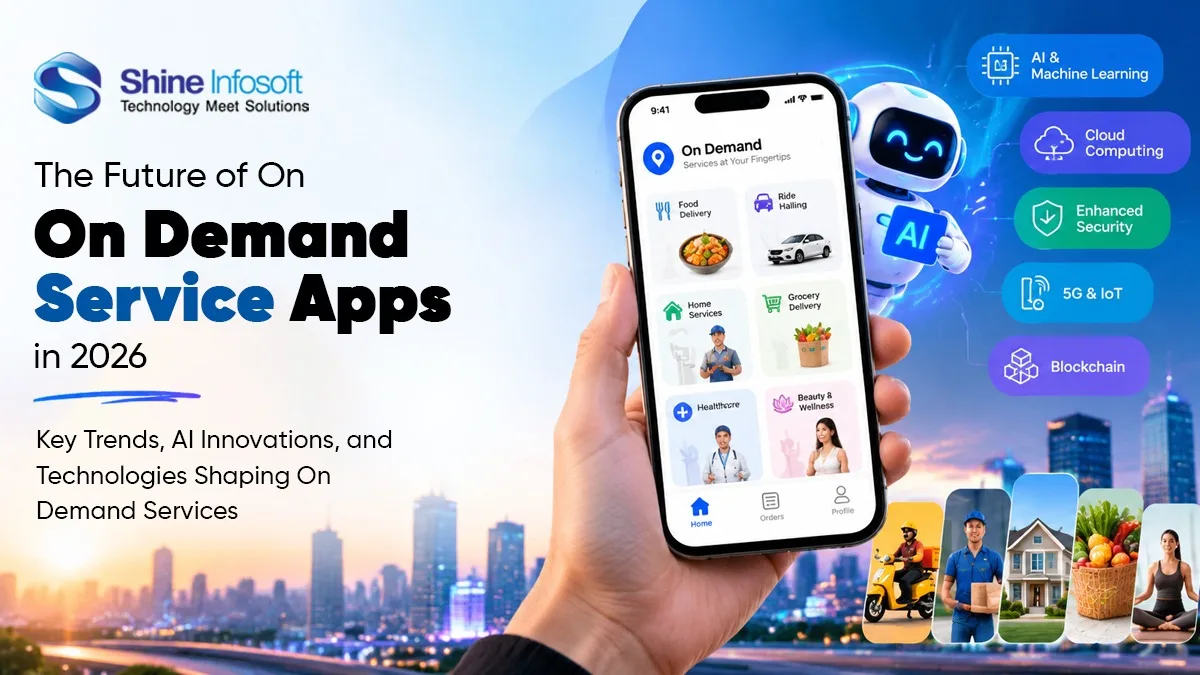
On-demand service apps have changed the way people access everyday services. Whether someone wants food delivered, a taxi booked, a cleaner hired, a plumber called, or a beauty appointment set, an app can help.
In 2026, the on-demand service app industry is entering a new stage. Users are no longer satisfied with simply having a mobile app that connects them with a service provider. They expect faster responses, better personalization, transparent pricing, secure payments, real-time updates, and a smooth overall experience.
At the same time, businesses use technologies like artificial intelligence, automation, location services, and smart analytics. These tools help improve how their services work.
So, what does the future of on-demand service apps look like in 2026? Let's explore the major trends that are shaping this rapidly growing industry.
What Are On-Demand Service Apps?
On-demand service apps are mobile applications that allow users to request products or services whenever they need them.
Instead of calling a business or visiting a physical location, users can open an app and choose a service. They can make a booking or order, then track the process on their phone.
Common examples include:
- Food delivery apps
- Taxi and ride-booking apps
- Home cleaning services
- Beauty and salon booking apps
- Grocery delivery apps
- Healthcare service apps
- Repair and maintenance apps
- Freelance and professional service platforms
The basic idea is simple: connect customers with the right service at the right time.
However, modern on-demand platforms are becoming much more advanced than simple service marketplaces.
Why On-Demand Apps Are Becoming More Important
Convenience is one of the biggest reasons behind the growth of on-demand services.
People are increasingly looking for services that save time and reduce effort. Users can complete many tasks in one app, instead of searching many websites, making phone calls, or waiting for replies.
For businesses, these apps can also provide better access to customers. A small service provider can reach people in a larger geographical area without investing heavily in physical locations.
The combination of convenience, mobile technology, digital payments, and changing customer expectations is creating strong opportunities for on-demand businesses in 2026.
1. AI Will Make On-Demand Apps Smarter
Artificial intelligence will be one of the biggest technologies influencing on-demand service apps in 2026.
AI can help apps understand customer behavior and provide more relevant recommendations. For example, a food delivery app can learn what a customer usually orders and suggest similar meals.
AI can also help businesses improve operations.
For example, an on-demand cleaning platform could use historical booking information to predict busy periods. The business can then make sure enough service providers are available during those times.
AI-powered chatbots and virtual assistants will also become more common. Users can get answers to basic questions, check booking information, or receive support without waiting for a human agent.
The goal is not simply to add AI to an app. The real value comes from using AI to make the customer experience faster and more useful.
2. Hyper-Personalization Will Improve Customer Experiences
Customers want services that feel relevant to them.
In 2026, on-demand apps will increasingly use customer data and behavior patterns to create personalized experiences.
An app may recommend services based on previous bookings, location, time of day, preferences, and usage history.
For example, a home service app could remind a customer that their regular cleaning appointment is due. A fitness service app could suggest classes based on previous bookings.
Personalization can make an application easier to use because customers spend less time searching for what they need.
However, businesses must also be careful about privacy and responsible data usage. Personalization should provide value without making users uncomfortable.
3. Faster and More Accurate Service Matching
Finding the right service provider is an important part of an on-demand platform.
Future apps will use better algorithms to match customers with providers based on multiple factors.
These may include:
- Location
- Availability
- Skills
- Ratings
- Previous customer feedback
- Estimated arrival time
- Service requirements
Instead of showing only the nearest available provider, an app can find the best provider for a specific request.
This can improve customer satisfaction while also helping service providers receive more relevant jobs.
4. Real-Time Tracking Will Become Standard
Real-time tracking has already become common in delivery and transportation apps. In 2026, this feature is expanding into more service categories.
Customers may be able to see when a technician, cleaner, healthcare professional, or other service provider is arriving.
For example, after a customer books an appliance repair service, they can get updates. The updates can include the provider’s location. They can also include the expected arrival time.
This level of visibility reduces uncertainty and makes the service experience more transparent.
Businesses also benefit because customers can better understand expected arrival times and service progress.
5. Digital Payments and Flexible Payment Options
Digital payments will remain an important part of on-demand service apps.
Customers increasingly expect multiple payment options instead of relying on cash or a single payment method.
Depending on the market, apps can support cards, digital wallets, bank transfers, and other local payment methods.
Flexible payment options can make checkout faster and reduce abandoned bookings.
Subscription-based payments and memberships are also likely to become more popular. For example, customers may pay a monthly fee to receive discounts, priority bookings, or free service fees.
This creates a recurring revenue opportunity for businesses while providing additional value to loyal customers.
6. Voice-Based Interaction Will Become More Useful
Voice technology is another area that can improve on-demand apps.
Instead of navigating through multiple screens, users may be able to use voice commands to request a service.
For example, a customer could say that they need a plumber for an urgent repair. The application could understand the request, identify suitable providers, and guide the customer through the booking process.
Voice interaction can be particularly useful when users are busy or when traditional app navigation feels inconvenient.
As voice recognition becomes more accurate, it could become an important part of the user experience.
7. More Focus on Trust, Safety, and Verification
Trust matters a lot for on-demand services. Customers may invite providers into their homes or share personal information online.
In 2026, businesses will need to focus more heavily on safety and verification.
Apps may offer features like verified provider profiles, ID checks, and background checks when needed. They may also include ratings, reviews, secure messaging, emergency help, and service history.
Transparent information can help customers feel more confident when booking a service.
Reviews will also continue to play an important role. Customers want to know about other people's experiences before choosing a provider.
8. Sustainability Will Influence On-Demand Services
Sustainability is becoming increasingly important for both businesses and consumers.
On-demand platforms can use technology to reduce unnecessary travel. They can map routes more effectively. They can combine closely located reservations. They can reduce wasted resources.
For delivery businesses, intelligent route optimization can help reduce travel distance and fuel consumption.
Some businesses may also introduce eco-friendly delivery options, electric vehicles, reusable packaging, or digital receipts.
Sustainability will not necessarily look the same across every service category, but technology can help businesses operate more efficiently while reducing their environmental impact.
9. Super Apps Could Bring Multiple Services Together
Another interesting trend is the growth of multi-service or "super app" platforms.
Instead of downloading separate apps for each service, users may prefer platforms that offer many services in one place.
A single application could potentially provide transportation, food delivery, grocery shopping, home services, payments, and other everyday solutions.
For users, this can make digital services more convenient. For businesses, it can create opportunities to cross-sell different services to existing customers.
However, building a successful super app requires a strong infrastructure and a consistent user experience across different services.
10. Businesses Will Use Data to Make Better Decisions
Data analytics will become increasingly important for on-demand service businesses.
Apps generate large amounts of information about bookings, customer behavior, service demand, cancellations, provider performance, and revenue.
Businesses can use this information to understand what is working and what needs improvement.
For example, analytics can show which services are most popular. It can show when demand is highest. It can show which locations need more providers. It can also show where customers often abandon bookings.
These insights can help companies make better operational and marketing decisions.
What Customers Will Expect From On-Demand Apps in 2026
Technology alone will not determine the success of an on-demand app. Customer expectations will be equally important.
Users will generally expect applications to be:
- Fast
- Easy to navigate
- Reliable
- Secure
- Transparent
- Personalized
- Mobile-friendly
- Responsive
An app with many features can still fail if users find it confusing or slow.
This is why user experience will remain one of the most important factors in on-demand app development.
Businesses should focus on making the booking process simple. Customers should be able to find a service easily.
They should be able to understand the price. They should be able to choose the right provider. They should be able to pay. They should be able to track the service.
Challenges Facing On-Demand Service Apps
Despite the opportunities, the industry also faces several challenges.
Competition is becoming stronger, making it difficult for new platforms to attract both customers and service providers.
Customer acquisition can also be expensive. Businesses need a clear value proposition to convince users to choose their platform over established competitors.
Data security is another major concern. On-demand applications often handle personal information, location data, payment details, and booking history. Strong security practices are therefore essential.
Businesses must also maintain service quality. A technically excellent application cannot compensate for poor service delivery.
The future winners will likely be companies that combine strong technology with reliable real-world services.
The Future of On-Demand Service App Development
The future of on-demand service apps is not simply about creating more applications. It is about building smarter platforms that solve real customer problems.
AI can make services more personalized. Automation can reduce manual work. Location technology can improve matching and tracking. Digital payments can simplify transactions. Analytics can help businesses make better decisions.
At the same time, companies need to focus on human needs such as trust, convenience, reliability, and customer support.
For businesses planning an on-demand service app in 2026, start with the customer’s problem, not the technology.
Ask what customers struggle with today.
Then design the application around solving that problem as simply as possible.
Conclusion
The future of on-demand service apps in 2026 looks promising. Artificial intelligence, personalization, real-time tracking, digital payments, automation, voice interaction, and smarter service matching are changing how customers and businesses connect.
However, technology is only one part of the equation.
The most successful on-demand apps will combine smart technology with an easy user experience. They will also offer reliable providers, strong security, clear pricing, and great customer support.
As customer expectations continue to grow, on-demand service platforms will need to become faster, smarter, and more convenient.
For businesses, 2026 presents a strong opportunity to build innovative on-demand solutions. For customers, it means easier access to the services they need, whenever and wherever they need them.