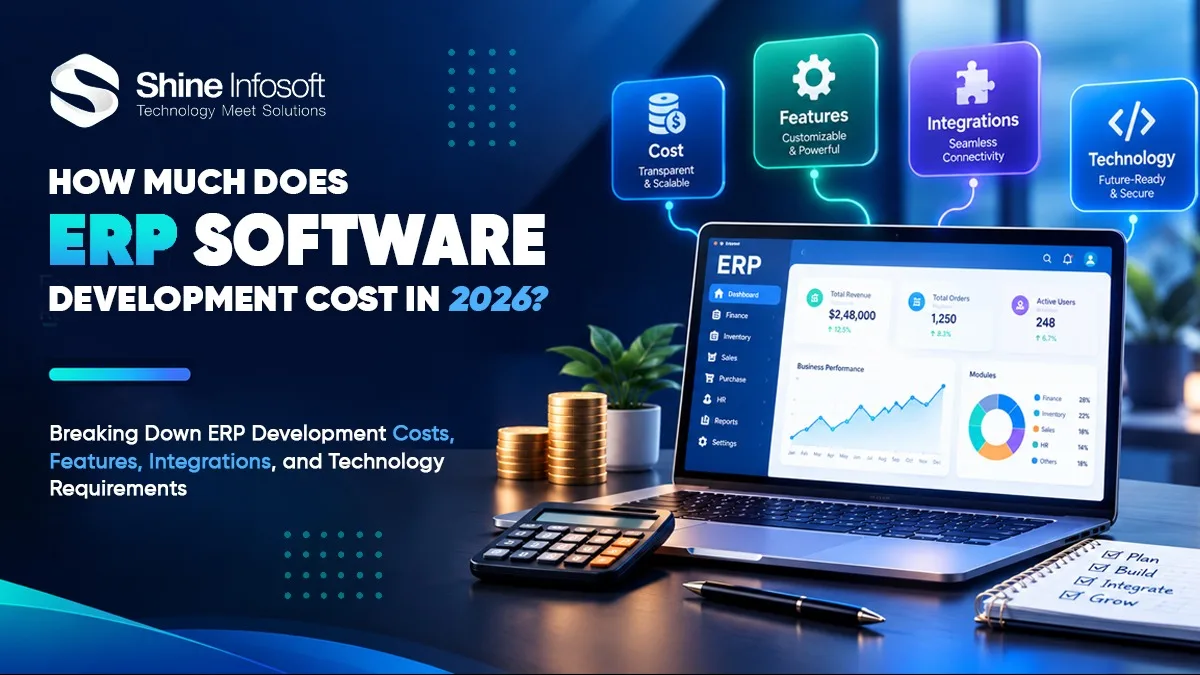
ERP software development has become an important part of how modern businesses manage their daily operations. From accounting and inventory to human resources, sales, purchasing, and customer management, an ERP system links key business activities. It brings them together on one platform.
But when a company plans an ERP project, one question comes first: How much will ERP software development cost in 2026?
There is no fixed answer because ERP software is not the same for every business. A small trading company may only need finance, inventory, purchasing, and sales modules.
A large manufacturing company may need production and warehouse management.
It may also need supply chain automation, payroll, CRM, and analytics. It may need integrations with several external systems.
In 2026, the cost to develop a custom ERP system often ranges from $40,000 to $500,000 or more. It depends on the project’s size and complexity. The number of modules, customization requirements, integrations, technology stack, security, user requirements, development team, and ongoing maintenance influence the final cost.
This article explains the key factors that affect ERP development costs. It also covers what businesses should consider before starting an ERP project.
What Is ERP Software?
ERP stands for Enterprise Resource Planning. Simply put, an ERP system is software that helps a business manage many departments and processes in one system.
Without an ERP, a company may use one app for accounting and another for inventory. It may use spreadsheets for employee information, a separate CRM for customers, and other tools for purchasing and reporting. As the business grows, managing all these systems can become difficult.
An ERP connects these processes.
For example, when a sales employee creates an order, the ERP can automatically update inventory. The purchase department can see when stock is low. The finance team can get the information needed for invoicing. Management can view the transaction in reports.
This connection between departments is one of the main reasons businesses invest in ERP software.
Modern ERP systems are also becoming more intelligent. Cloud infrastructure, automation, real-time reporting, analytics, and AI-powered tools are key for companies planning new ERP platforms.
How Much Does ERP Software Development Cost in 2026?
The development cost depends largely on the size of the ERP system.
A relatively simple ERP with a few core modules may cost around $40,000 to $80,000. A medium-sized ERP with more business processes, integrations, and customization can cost approximately $80,000 to $180,000.
More advanced ERP platforms can cost between $180,000 and $350,000, while large enterprise systems can go beyond $500,000 when they involve complex workflows, multiple locations, advanced security, large-scale integrations, analytics, mobile applications, and AI capabilities.
These figures should be treated as planning ranges rather than fixed prices.
For example, two companies may both request an ERP with inventory management, but their requirements can be completely different. One business may only need basic stock tracking. Another may need multiple warehouses, barcode scanning, batch management, and serial numbers. It may also need stock forecasting, automated purchase orders, and e-commerce platform integration.
The module name is the same, but the development effort is very different.
Why Does ERP Development Cost So Much?
ERP software is more complex than a standard business website or a simple mobile app. It becomes part of the company's operational infrastructure.
An ERP does not simply display information. It manages business rules and connects processes between departments.
Consider a purchase transaction. A company may want an employee to create a purchase request, send it to a manager for approval, compare multiple vendors, generate a purchase order, receive the goods into inventory, update stock levels, record the supplier invoice, and finally send the transaction to the accounting system.
Every step has its own rules.
Different employees may have different permissions. Certain purchases may require multiple approvals. Some products may have different tax rules.
Inventory may need to be updated immediately. Financial records need to remain accurate.
Building all these processes into reliable software requires considerable planning, development, testing, and maintenance.
ERP Modules and Their Impact on Development Cost
The number of modules is one of the most visible factors that affects ERP development cost. The complexity of each module is just as important.
Finance and accounting are usually at the center of an ERP system. Businesses may need invoicing, expenses, accounts payable, accounts receivable, taxation, budgeting, financial reporting, and payment tracking.
Inventory management is another common requirement. A simple inventory module may only track stock quantities. A more advanced system may need to manage many warehouses, stock transfers, product variants, batches, and serial numbers.
It may also support barcode scanning, stock adjustments, and inventory valuation.
Human resource management can include employee records, attendance, leave, payroll, recruitment, performance management, and employee self-service.
Sales and CRM functionality can manage leads, customers, quotations, sales orders, invoices, communication history, and sales pipelines.
Manufacturing businesses often require additional functionality such as production planning, bills of materials, work orders, raw material management, quality control, and production reporting.
This is why simply counting the number of modules is not enough to estimate an ERP project. The actual workflows inside those modules need to be understood first.
Custom ERP vs Ready-Made ERP
Businesses generally have two choices: use an existing ERP product or develop a custom ERP system.
Ready-made ERP software can be faster to implement because many common features already exist. However, businesses may need to change their processes to match the software, or pay for additional customization.
Custom ERP development takes more time and needs a larger upfront investment. However, it lets the software match the company's real business processes.
For example, a company with a unique approval system may find a custom ERP more suitable.
This can also apply to specialized pricing calculations, industry-specific inventory processes, or complex customer workflows.
The right decision depends on the business rather than simply choosing the cheaper option.
How Customization Changes ERP Development Cost
Customization is one of the biggest reasons ERP projects become more expensive than the original estimate.
A business may initially request a standard sales module. During discussions, additional requirements can appear.
For example, the company may want different pricing rules for different customers. It may want special discounts based on order volume. It may want automatic approval for high-value orders.
It may want custom invoice formats. It may want automated email notifications. It may want different sales workflows for different branches.
Each additional requirement introduces more business logic.
Customization also affects testing. When a workflow is customized, developers and QA teams must test different scenarios. This helps ensure one change does not break another part of the ERP.
For this reason, companies should document their business processes before development begins. A clear requirement document can prevent unnecessary scope changes later.
The Role of Integrations in ERP Cost
A modern ERP rarely operates alone.
Businesses often need their ERP to communicate with other software and services. For example, an online retailer may need the ERP to connect with its website, payment gateway, shipping provider, CRM, accounting software, and email platform.
A manufacturing company may need connections with suppliers, warehouse systems, barcode devices, production machines, or external reporting platforms.
Every integration requires technical work. Developers need to understand the external API, authentication process, data format, error handling, synchronization rules, and security requirements.
For example, when an e-commerce order is created, the ERP may need to receive it. It may verify the customer. It may update inventory. It may generate an invoice. It may send the required details to the shipping system.
If the integration fails, the ERP should be able to detect the problem and prevent incorrect or duplicate transactions.
This is why you should discuss integrations early in planning, not add them at the end of development.
Technology Stack for ERP Development
The technology stack also plays a role in the overall cost of an ERP project.
A typical modern ERP may use a frontend framework such as React, Angular, or Vue, with a backend built using technologies such as Laravel, Node.js, .NET, Java, or Python.
The database could be MySQL, PostgreSQL, Microsoft SQL Server, or another enterprise database depending on the project requirements.
For cloud deployment, businesses may use platforms such as AWS, Microsoft Azure, or Google Cloud.
The system may introduce other technologies as it grows. Redis can be used for caching and queues. Search tools can improve performance when the ERP has lots of searchable data.
The important point is that you should select technology according to the project requirements. Choosing a technology simply because it is popular can create unnecessary problems later.
The ERP needs to be reliable, secure, scalable, maintainable, and compatible with the organization's existing technology environment.
Cloud ERP Development in 2026
Cloud deployment is now common for modern ERP systems. It lets employees access the application from many locations. It does not rely on a company’s physical servers.
A cloud ERP can also make it easier to scale resources as the number of users and transactions increases.
However, cloud deployment does not mean that infrastructure is free. Businesses need to consider computing resources, databases, storage, backups, monitoring, security, bandwidth, and third-party services.
Cloud costs can also increase as the ERP grows.
This is why infrastructure planning should be part of the ERP architecture from the beginning. A system that works well for 50 users may require different infrastructure when it reaches 500 or 5,000 users.
AI and Automation in ERP
AI is another important consideration for ERP development in 2026.
Businesses are increasingly looking at ways to reduce repetitive manual work and extract useful information from their operational data.
For example, AI can help process invoices, identify unusual transactions, generate business summaries, assist employees with ERP-related questions, and support demand forecasting.
Imagine a purchasing manager opening the ERP and asking, "Which products are likely to run out of stock next month?" Instead of checking many reports by hand, an AI system could review past sales, current inventory, and purchasing data. It could then provide a clear, useful summary.
However, organizations should not add AI simply because it is a popular technology. It should solve a real business problem and work with reliable business data.
The quality of the underlying ERP data is especially important. If the company's data is incomplete or inaccurate, AI-generated insights may also be unreliable.
Security Requirements for ERP Software
Security is a critical part of ERP development because ERP systems contain sensitive business information.
The system may store employee records, salaries, customer information, financial transactions, supplier details, business documents, and internal reports.
A good ERP should therefore have proper authentication and authorization mechanisms.
For example, a sales employee may access customer and order information. They should not have automatic access to payroll or sensitive financial records.
Role-based access control allows administrators to define what different users can view or modify.
Other security requirements may include encrypted communication, secure password policies, multi-factor authentication, audit logs, backups, vulnerability testing, and monitoring.
Developers should consider security from the beginning of development rather than treat it as a final step before launch.
ERP Development Team and Cost
The development team also affects the final budget.
A typical ERP project may involve a project manager, business analyst, UI/UX designer, frontend developer, backend developer, database specialist, QA engineer, and DevOps professional.
For larger ERP projects, you may also need security specialists, data migration experts, ERP consultants, and dedicated support teams.
The cost of development can vary considerably depending on the location and experience of the team.
However, selecting a development partner based only on the lowest hourly rate can create problems. ERP software is a long-term business system. So technical quality, clear communication, experience, security, testing, and support after launch all matter.
How Long Does It Take to Develop ERP Software?
Development time depends on the scope.
A small ERP may take approximately three to six months.
A medium-sized ERP can take six to twelve months.
A complex ERP may require twelve to eighteen months or longer.
Large enterprise implementations can take considerably longer because they may involve multiple departments, locations, legacy systems, data migration, complex integrations, and extensive testing.
The development process normally starts with requirements and business process analysis. This is followed by architecture and UI/UX design. Next comes development, integration, and testing.
Then we handle data migration and user acceptance testing. Finally, we do deployment and support.
Rushing an ERP project can cause serious problems. Errors in one module can affect other business processes.
Hidden Costs You Should Consider
The development quotation is only one part of the total ERP investment.
Businesses should also plan for data migration, employee training, cloud hosting, third-party services, security testing, backups, monitoring, maintenance, and future enhancements.
Data migration is particularly important.
A company may have years of customer, product, supplier, employee, and financial information stored in spreadsheets or older software. Moving that information into a new ERP requires cleaning, mapping, validating, and testing the data.
Training is another area that should not be ignored.
Even a technically excellent ERP can fail to deliver value if employees do not understand how to use it. Training and documentation help employees adapt to the new system and reduce resistance to the change.
How to Control ERP Development Costs
The best way to control ERP development cost is not necessarily to reduce the development team's hourly rate. It is to control the project scope and build the right features in the right order.
A business can start with the processes that have the greatest operational impact.
For example, a distribution company may begin with inventory, purchasing, sales, and finance. Once those modules are stable, it can add advanced analytics, mobile applications, automation, CRM improvements, or AI features.
This approach reduces the initial investment while allowing the ERP to evolve with the company.
Clear requirements are equally important. Every major workflow should be documented before development begins. This makes it easier to estimate effort and reduces expensive changes during development.
Final Thoughts
So, how much does ERP software development cost in 2026?
For a custom ERP system, costs can start around $40,000 for a small solution. They can exceed $500,000 for a complex enterprise platform. The actual cost depends on what the business needs the ERP to do.
The biggest cost factors include the number and complexity of modules, customization, integrations, security, technology requirements, data migration, cloud infrastructure, development team, and long-term maintenance.
The most important thing is not to decide the ERP budget based on a single price range. Businesses should first understand their processes and identify the problems the ERP needs to solve.
A well-planned ERP can centralize business data and reduce repetitive work. It can improve visibility, automate workflows, and give managers better decision-making information. But achieving those benefits requires careful planning, realistic budgeting, good software architecture, and continuous improvement after launch.
For companies planning ERP development in 2026, start with a clear requirements document and a defined MVP. This makes development more predictable and helps control both short-term and long-term costs.